Intent-Based Lead Generation in the AI Search Era: The 4-Tier Prompt Ladder
Keyword-based lead gen is dead in AI search. Here is the 4-tier prompt ladder B2B teams use to generate qualified pipeline from ChatGPT, Perplexity, Gemini, and Claude.
The old lead gen playbook was built on keywords. Rank for "best CRM software," run paid ads against "CRM for startups," capture the traffic, nurture the form fill.
That playbook is breaking.
In AI search, your buyer does not type a keyword. They type a full question, get a synthesized answer, and click through only when the answer mentions a vendor they want to evaluate. No click, no pipeline.
What works now is intent-based lead generation: matching your content to the specific kind of question a buyer asks at each stage of their decision, so you are the vendor named in the answer.
This post walks through the 4-tier prompt ladder and what each tier requires to convert.
Why keywords no longer map to intent
Keywords compress intent. "CRM software" could be a student writing a paper, a founder evaluating tools, or a sysadmin looking for pricing. Search engines handled this by showing 10 results and letting the user sort it out.
AI engines do not show 10 results. They synthesize one answer. And to synthesize, the model has to decide which intent the prompt carries, then pull from sources that match that intent specifically.
The practical effect: content that ranked for a broad keyword in Google may never appear in an AI answer because the model judged it off-intent.
You cannot fix this with more keywords. You fix it by mapping content to intent tiers, which is what the ladder below is for.
The 4-tier intent ladder
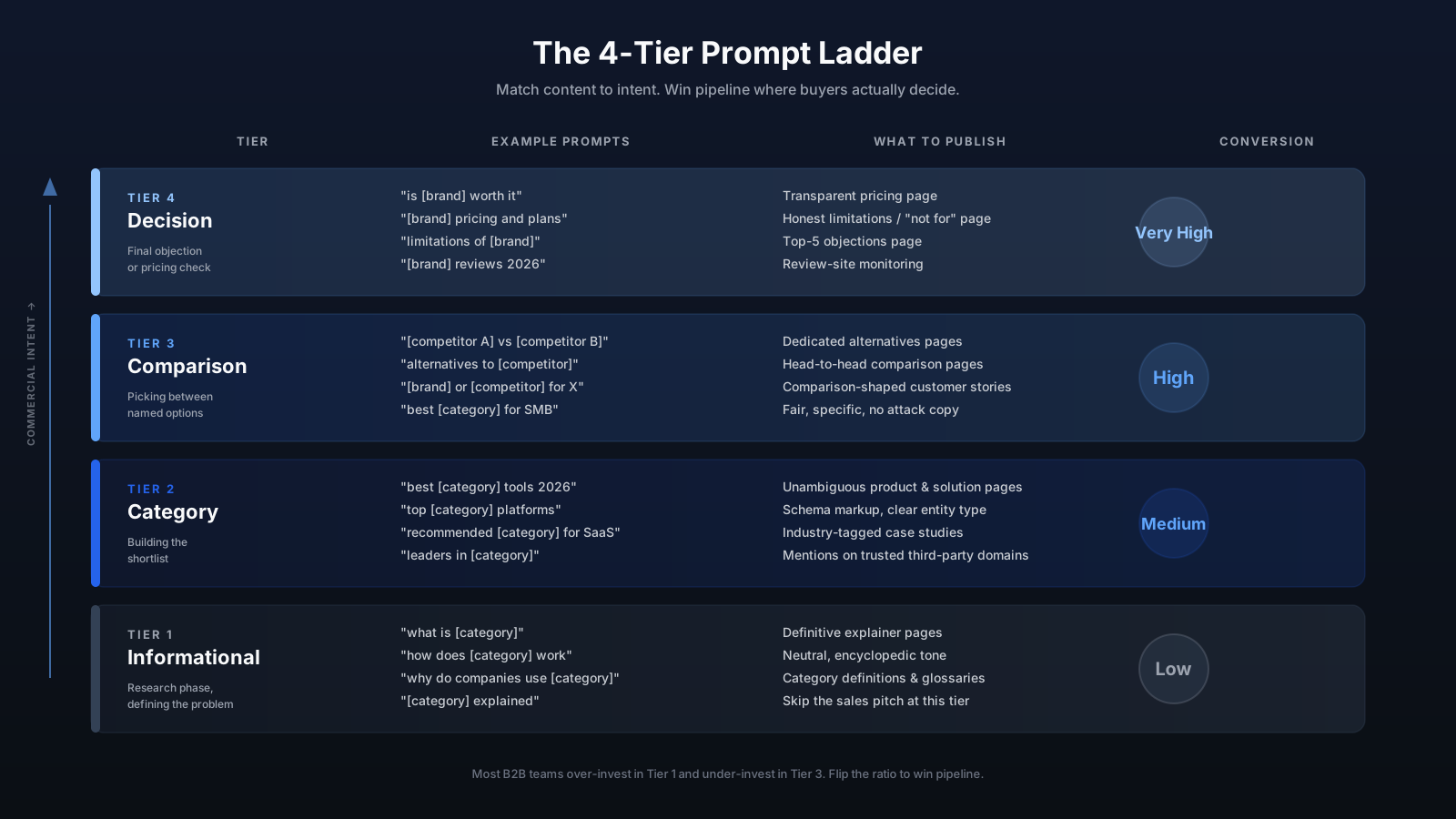
Every commercial prompt a buyer types falls into one of four tiers. Each tier pulls from a different kind of content, and each tier converts at a different rate.
Tier 1: Informational
Example prompts:
- "what is [category]"
- "how does [category] work"
- "why do companies use [category]"
What the model pulls: Encyclopedic content. Definitions, glossaries, neutral explainers. Rarely names specific vendors.
Conversion potential: Low. These are top-of-funnel, research-phase prompts. The buyer is still defining the problem.
What to publish: Definitive explainer pages on your domain. The goal here is not to be cited as a product, but to be the source the model quotes when defining the category. If the model pulls your definition, your brand gets imprinted as a category authority.
Skip: Do not try to hard-sell at this tier. If your definition page pitches your product, the model will pass over it in favor of a neutral source.
Tier 2: Category
Example prompts:
- "best [category] tools for [segment]"
- "top [category] platforms in 2026"
- "recommended [category] for [industry]"
What the model pulls: Listicles, comparison posts, industry roundups. Heavily weights third-party sources: review sites, analyst reports, trade publications.
Conversion potential: Medium. The buyer is building a shortlist. Appearing here means you make the evaluation set.
What to publish:
- A product page that is unambiguous about category and segment
- Schema markup with clear entity type
- Case studies tagged to the relevant industry or segment
What to earn: Mentions on the specific third-party domains the models already trust for your category. You identified these in your baseline audit. If you cannot be cited on your own domain, you need to be cited on theirs.
Tier 3: Comparison
Example prompts:
- "[competitor A] vs [competitor B]"
- "alternatives to [competitor]"
- "[your brand] or [competitor] for [use case]"
What the model pulls: Comparison pages, alternatives pages, forum threads, and customer review snippets. This tier is highly specific. If you do not have a page directly answering the comparison, you will not appear.
Conversion potential: High. Buyers at this tier have already decided they want a product in the category. They are now picking between named options.
What to publish:
- A dedicated alternatives page for each major competitor your buyers mention
- A head-to-head comparison page for the 2 to 3 competitors you win against most often
- Customer stories written around comparison-shaped questions
What to skip: Attack pages. Models detect hostility and down-rank them. Write comparison content that is fair and specific. The fair version outperforms the aggressive version in AI answers almost every time.
Tier 4: Decision
Example prompts:
- "is [your brand] worth it"
- "[your brand] pricing and plans"
- "limitations of [your brand]"
What the model pulls: Your own product and pricing pages, plus review sites and customer forum threads.
Conversion potential: Very high. The buyer has narrowed to you and is looking for the final nudge or the final objection.
What to publish:
- A transparent pricing page with the actual prices, not "contact sales"
- An honest limitations or "not for" page that names the buyers you do not serve
- A page answering the top 5 objections your sales team hears
What to monitor: Review sites and forum threads where you are named. One unanswered negative thread can dominate the synthesized answer at this tier. If the model reads "customers complain about onboarding" as the dominant signal, that becomes the answer, regardless of what your site says.
The tier-conversion correlation
Most B2B teams distribute effort roughly like this:
- Tier 1 (informational): 60% of content production
- Tier 2 (category): 20%
- Tier 3 (comparison): 10%
- Tier 4 (decision): 10%
The conversion rate distribution is almost exactly the inverse. Tier 3 and tier 4 prompts produce the bulk of qualified pipeline, and they are where most teams under-invest.
A useful rule: before you publish another explainer, ask whether you have a dedicated page for every major competitor alternatives query and every pricing objection a buyer types. If the answer is no, that work should come first.
What "qualified lead" looks like when it arrives from AI search
A buyer who finds you through AI search behaves differently from a keyword-driven lead. Three signals to watch:
Signal 1: Shorter discovery calls. The buyer already knows what your product does, what tier they are in, and what they compared you against. First calls run 20 to 30 minutes instead of 45 to 60.
Signal 2: Better-qualified fit. Because the model pre-sorted by intent, the buyers who reach out are closer to your ICP. Unqualified tire-kicker calls drop materially.
Signal 3: Higher comparison specificity. Buyers will say "I was comparing you to X and Y" unprompted. That is a lead from tier 3 content. If you are not publishing tier 3 content, you will not hear this sentence.
Track these signals in your CRM. They are the earliest measurable proof that intent-based lead generation is working.
The 30-day intent audit
If you want to run this on your own before building a formal program:
Week 1: Pull your 25 highest-value commercial prompts. Classify each into tier 1, 2, 3, or 4.
Week 2: Run each prompt through ChatGPT, Perplexity, Gemini, and Claude. Record whether you appear.
Week 3: For each tier, calculate your appearance rate. Most teams find a dramatic drop-off at tier 3.
Week 4: Identify the 5 tier-3 and tier-4 prompts with the largest gap to your strongest competitor. Those are your next 5 content briefs.
A 30-day audit plus 5 targeted pages usually moves citation rate on commercial-intent queries by 20 to 40% inside a quarter. This is the ROI profile most teams want but miss because they default to tier-1 content production.
The bottom line
Keyword-based lead generation assumed 10 results and a user doing the sorting. AI search gives one answer and the model does the sorting. You earn pipeline by matching your content to the intent tier where the prompt lives, not by chasing keyword volume.
Tier 1 builds authority. Tier 2 gets you shortlisted. Tier 3 is where real pipeline is won. Tier 4 is where it closes. Most teams over-invest in tier 1 and under-invest in tier 3.
Fix that ratio and the pipeline follows.
Want to see which tier your brand is strongest and weakest in, across all four major AI engines? NextGenIQ classifies every prompt by intent tier, shows your appearance rate per tier, and flags the tier-3 and tier-4 gaps where you can earn the fastest pipeline lift.
Run a free intent-tier audit to see your tier-by-tier breakdown in 60 seconds. No credit card, no sales call.
See what ChatGPT says about your brand.
NextGenIQ runs your real buyer prompts across ChatGPT, Perplexity, Gemini, and Claude. Get your AI visibility score in 60 seconds.
Check Your AI Visibility for Free