From AI Visibility Data to Qualified Pipeline: A 7-Step Playbook
Most AI visibility work stalls at the dashboard. Here is the exact 7-step playbook to turn citation and recommendation data into qualified pipeline for B2B.
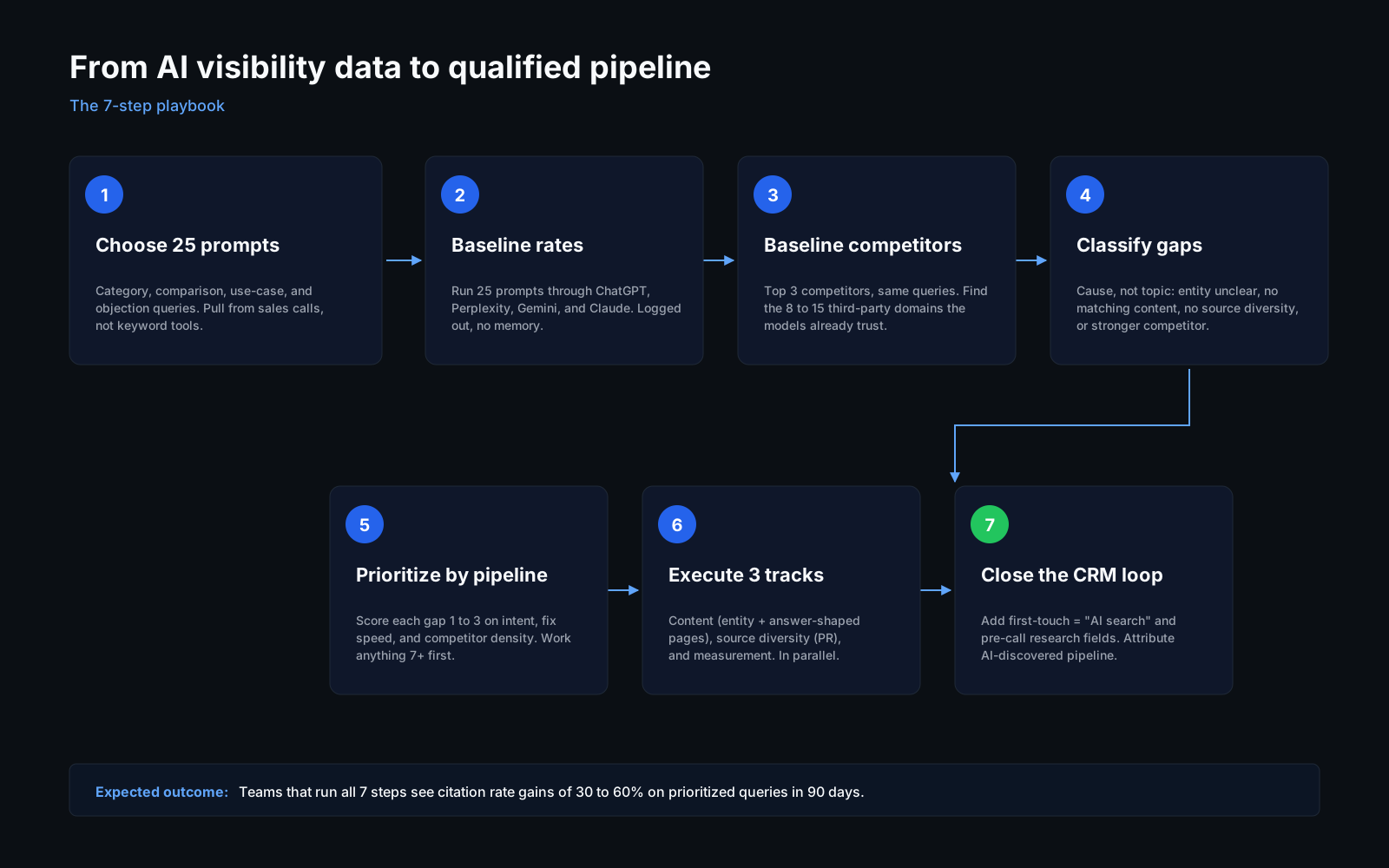
Most B2B teams now know their AI citation rate. Far fewer know what to do with the number.
The dashboard says you appear in 12% of commercial-intent answers. Your competitor appears in 47%. Now what?
This is the exact playbook we run with B2B teams to move from "we know the gap" to "we are closing it and it is showing up in pipeline." Seven steps, in order, with what to do and what to skip at each one.
Step 1: Choose 25 prompts that actually match your pipeline
The first mistake most teams make is measuring too broadly.
You do not need to track every question ever asked in your category. You need to track the 25 prompts a real buyer types when they are seriously evaluating a purchase.
A useful prompt set covers four intent layers:
- Category queries (5 to 8 prompts): "best [category] tools for [segment]"
- Comparison queries (5 to 8 prompts): "[competitor] vs [competitor]", "alternatives to [competitor]"
- Use-case queries (5 to 7 prompts): "[category] for [industry]", "how to solve [specific problem]"
- Objection queries (4 to 5 prompts): "is [category] worth it", "[category] pricing", "limitations of [category]"
Pull these from sales call recordings, not from a keyword tool. Your sales team already knows the questions buyers ask. Those are the prompts AI engines are answering.
Skip: awareness-stage questions. They are high volume and low pipeline value. Not worth your measurement time.
Step 2: Baseline your citation and recommendation rates
Run each of your 25 prompts through ChatGPT, Perplexity, Gemini, and Claude, logged out, no memory.
For each answer, record four things:
- Does your brand appear? (yes/no)
- Is it cited with a link, named in text, or recommended in a list?
- Which competitors also appear?
- What source URLs does the engine link to?
This is 100 data points (25 prompts times 4 engines) and takes about two hours manually. You can do it in a spreadsheet the first time.
At the end, you will have:
- Citation rate: your links across all 100 answers
- Recommendation rate: brand mentions in commercial-intent answers specifically
- Competitor share: who else is showing up, and how often
- Source map: which external domains the engines trust for your category
This baseline is non-negotiable. Every subsequent step is calibrated against it.
Step 3: Run the same baseline for your top 3 competitors
Repeat the same 100 queries, but this time record whether each competitor appears.
You are looking for two things:
Relative position: are you below, at, or above each competitor on each intent layer? You may be strong on comparison queries and weak on category queries, or the reverse. The gap is almost never uniform.
Shared sources: which third-party domains keep showing up when competitors are cited but you are not? Those are the sites you need to appear on. Not domains in general. These specific domains, which the models have already decided are authoritative for your category.
This is often the highest-leverage data point in the whole playbook. A list of 8 to 15 domains the models trust is more useful than a list of 500 backlink opportunities from a generic SEO tool.
Step 4: Classify your gaps by cause, not by topic
For every prompt where a competitor appears and you do not, ask one question: why are they being cited?
There are usually only four reasons, and the fix is different for each:
Gap type A: Entity unclear. The model cannot tell what category you serve or what buyer you are for. Fix: rewrite your homepage, solution pages, and about page for category-and-outcome specificity.
Gap type B: No matching content. The model has nothing on your domain to quote for this question. Fix: publish answer-shaped content (comparison, alternatives, buyer's guide) that directly answers the prompt.
Gap type C: No source diversity. Your content exists, but the model weighs third-party corroboration and you have none. Fix: earn mentions on the domains you identified in Step 3.
Gap type D: Competitor is demonstrably stronger on this query. The competitor has a dedicated page, a better case study, or a longer track record for this use case. Fix: decide whether to compete (and build a stronger page) or concede and focus energy elsewhere.
Most teams have a mix of all four. The ratio tells you where to invest.
Step 5: Prioritize by pipeline impact, not by volume
Now you have gaps, causes, and fixes. You cannot do all of them at once. Rank by expected pipeline impact, not by query volume.
Score each gap on three dimensions (1 to 3):
- Intent: commercial (3), comparative (2), informational (1)
- Fix speed: weeks (3), months (2), quarters (1)
- Competitor density: fewer than 3 competitors cited (3), 3 to 5 (2), 6 or more (1)
Add the scores. Work on anything scoring 7 or higher first. These are the gaps where you can show up quickly, buyers have commercial intent, and the shortlist is not already crowded.
Most teams find 6 to 10 queries in this tier. That is your sprint-one scope.
Step 6: Execute in three parallel tracks
Do not run AI visibility work as a single project with a single owner. It is three jobs that need three different motions:
Track 1, Entity and on-site content (Content team). Rewrites to homepage, solution pages, and about pages for clarity. Net-new comparison, alternatives, and buyer's guide pages. Schema completion. Two-week sprints. Publish, measure, iterate.
Track 2, Source diversity (PR and community). Target the 8 to 15 domains from Step 3. Pitch analysts, podcast hosts, newsletter authors, and relevant subreddits or communities. Two to three confirmed mentions per quarter is the realistic target for most teams.
Track 3, Measurement and iteration (Analytics or ops). Re-run the baseline every two weeks for the first quarter, monthly after. Track which specific changes moved which specific queries. Kill tactics that do not move the number within 60 days.
These tracks can and should run in parallel. The mistake is sequencing them. Entity fixes compound faster when new content is live. Source diversity compounds faster when your own entity is clear.
Step 7: Close the loop between AI visibility and pipeline
This is the step most teams skip, and it is the one that makes everything else budget-defensible.
Add two fields to your CRM:
- First-touch channel = "AI search" (when reported by the buyer, or inferred from self-reported "how did you hear about us")
- Pre-call research behavior (captured by the SDR during the intro call)
Then, quarterly, compare:
- Share of deals where the buyer said they discovered or researched you via an AI engine
- Deal velocity and win rate for AI-discovered buyers vs. other channels
- Correlation between AI citation rate improvements and these CRM signals, on a 1 to 2 quarter lag
You will typically see two patterns within two quarters. First, AI-discovered buyers have shorter cycles because they arrive pre-educated. Second, win rates are higher because the model effectively pre-qualifies the match.
Once you can show that, AI visibility stops being a "marketing experiment" and becomes a pipeline line item.
What the first 90 days usually look like
If you start this playbook today, a realistic trajectory is:
Days 1 to 14: steps 1 through 4. Baseline done, gaps classified, priorities set.
Days 15 to 45: step 6, track 1. First entity rewrites live. First two answer-shaped pages published. First re-measurement shows movement on 2 to 4 queries.
Days 30 to 75: step 6, track 2 begins. First one or two third-party mentions land. Measurement starts showing source-diversity effects.
Days 60 to 90: step 7 activated. First pipeline signals surface. Second round of content shipped. By day 90, most teams see citation rate improvements of 30 to 60% on the prioritized query set and at least one closed deal attributable to AI-surfaced discovery.
The teams that do not see this usually skipped Step 1 and measured everything, or skipped Step 4 and wrote content without understanding the actual gap.
The one-sentence version
AI visibility becomes pipeline when you measure the right 25 prompts, classify gaps by cause, prioritize by pipeline impact, execute in three parallel tracks, and close the loop in your CRM.
Everything else is noise.
Want this running automatically instead of in a spreadsheet? NextGenIQ benchmarks your prompt set against competitors across all four major engines, classifies gaps, and flags which content and source-diversity actions moved the number week over week.
Run a free baseline audit to see your starting position in under 60 seconds. No credit card, four engines, side-by-side competitor comparison.
See what ChatGPT says about your brand.
NextGenIQ runs your real buyer prompts across ChatGPT, Perplexity, Gemini, and Claude. Get your AI visibility score in 60 seconds.
Check Your AI Visibility for Free